Le projet
Un modèle pédagogique transdisciplinaire
SEED-ED est une initiative pédagogique fondée sur l'apprentissage par le défi (challenge-based learning), développée dans le cadre de l'alliance universitaire européenne CHARM-EU. Elle engage les étudiants dans la conception de supports de médiation scientifique à destination du grand public, à partir de collections botaniques vivantes et de collections fossiles.
Les étudiants choisissent librement leur angle scientifique : conservation des espèces, écologie urbaine, One Health ou biogéographie, puis produisent des panneaux multilingues installés dans des jardins botaniques et accessibles en ligne via QR code, accompagnés de rapports de recherche déposés sur HAL.
🌱
Apprentissage par le défi
Les étudiants définissent leurs propres questions de recherche et produisent des résultats concrets, socialement pertinents.
🔬
Biodiversité & conservation
Transformer les collections scientifiques en outils éducatifs accessibles à tous les publics.
🌍
Science ouverte
Tous les contenus sont librement accessibles en trois langues via une plateforme numérique dédiée.
Impact international
Jusqu'au congrès ATBC 2026
Au-delà des jardins botaniques, SEED-ED rayonne à l'échelle internationale. En 2026, le projet a financé la participation de 4 étudiants au 62e congrès annuel de l'Association for Tropical Biology and Conservation (ATBC), tenu à Xishuangbanna, Chine. Ils y ont présenté leurs travaux devant une audience internationale de biologistes tropicaux.
ATBC 2026 · Xishuangbanna, Chine · Workshop
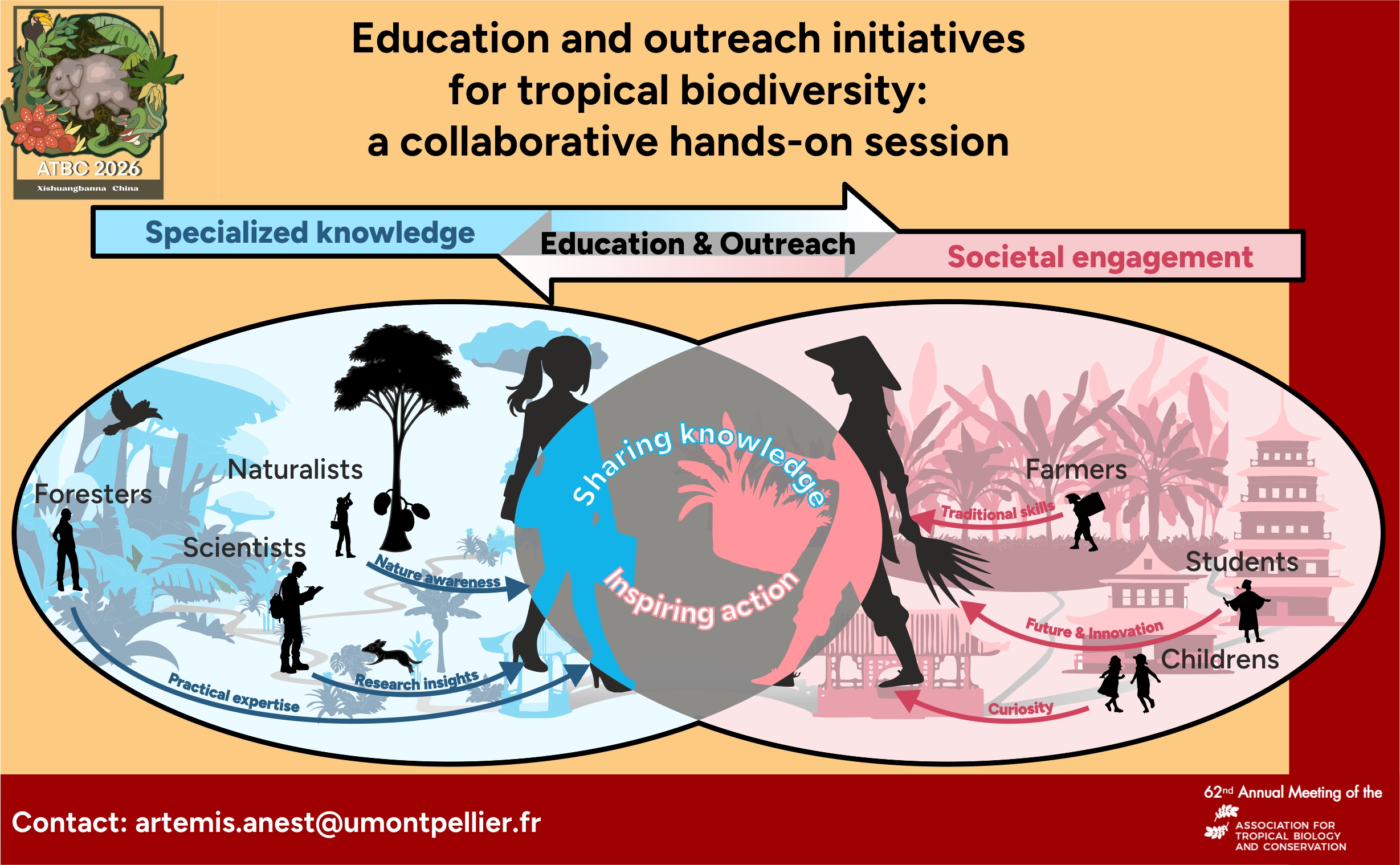
Education and outreach initiatives for tropical biodiversity: a collaborative hands-on session
Un workshop que j'organise et co-préside avec Ma. Niña Regina Quibod (XTBG), rassemblant des chercheurs de Tanzanie, des Philippines, de France et d'Irlande autour des pratiques de médiation scientifique pour la biodiversité tropicale.
40+
Participants au workshop
🐘🌿
ATBC 2026Xishuangbanna
China
Le programme comprend des mini-talks de 5 à 10 minutes présentant des initiatives d'outreach de plusieurs pays, suivis d'un atelier interactif de 30 à 40 minutes permettant aux participants de co-développer de nouvelles idées ou d'adapter des initiatives existantes, créant ainsi de nouvelles collaborations institutionnelles et internationales.
Flyer du workshop ATBC 2026 - Education and outreach initiatives for tropical biodiversity
Déroulement
De la salle de cours au jardin botanique
Dans l'UE d'Architecture Végétale de la Licence Biologie-Écologie de l'Université de Montpellier, les étudiants de L3 travaillent en groupes sur une espèce présente dans le Jardin des Plantes. Ils formulent une problématique scientifique, conduisent leur analyse, rédigent un contenu accessible en trois langues, et conçoivent un panneau installé à proximité de l'espèce.
Les meilleurs travaux sont sélectionnés pour être imprimés et installés physiquement dans le jardin. Les versions numériques sont accessibles via QR code, et les rapports de recherche associés sont déposés sur HAL avec un DOI permanent.
Ce dispositif fait du Jardin des Plantes un espace vivant de diffusion scientifique, où chaque visite peut devenir une expérience d'apprentissage, pour les promeneurs comme pour les chercheurs.
🌿 Voir les panneaux installés
Étudiants en travaux pratiques au Jardin des Plantes de Montpellier
Chronologie
SEED-ED en trois phases
2024–25
Partie 1 - Collections vivantes (Montpellier) ✓ Complété
Conception et installation des premiers panneaux au Jardin des Plantes de Montpellier. Validation du modèle pédagogique challenge-based. Webinar international UM–TCD (juin 2025).
2025–26
Partie 2 - Collections fossiles & ATBC En cours
Extension aux collections fossiles (Montpellier) et aux collections vivantes de Trinity College Dublin. Financement de 4 étudiants pour présenter leurs travaux au congrès ATBC 2026 à Xishuangbanna, Chine.
2026–27
Partie 3 - Herbier & déploiement CHARM-EU
Extension vers les collections d'herbiers (Allemagne ?) et consolidation du modèle comme cadre éducatif transférable au sein de l'alliance CHARM-EU.
Événement · 5 juin 2026
Webinar - Outreach Initiatives: Promoting Collections and Biodiversity
Vendredi 5 juin 2026 · 14h30 Paris · 13h30 Dublin
🎙 Rejoindre le webinar
Partenaires
Une collaboration européenne et internationale
UM
Université de Montpellier
Institution coordinatrice. Jardin des Plantes, Licence Biologie-Écologie, AMaplab.
TCD
Trinity College Dublin
Partenaire européen. Collections botaniques et fossiles, coordination Thibault Durieux.
XTBG
XTBG · Académie des Sciences de Chine
Partenaire international. Hôte du congrès ATBC 2026, soutien aux traductions chinoises.
CHARM-EU
CHARM-EU Alliance
Financeur principal. Alliance interuniversitaire européenne co-financée par Erasmus+.
The project
A transdisciplinary pedagogical model
SEED-ED is an educational initiative based on challenge-based learning, developed within the European university alliance CHARM-EU. It engages students in designing science communication materials for the general public, using both living botanical collections and fossil collections.
Students freely choose their scientific angle: species conservation, urban ecology, One Health or biogeography, and produce multilingual panels physically installed in botanical gardens and accessible online via QR code, alongside research reports deposited on HAL.
🌱
Challenge-based learning
Students define their own research questions and produce concrete, socially relevant outputs.
🔬
Biodiversity & conservation
Transforming scientific collections into educational and conservation tools accessible to all audiences.
🌍
Open science
All content is freely accessible in three languages on a dedicated digital platform.
International impact
All the way to ATBC 2026
Beyond botanical gardens, SEED-ED has an international reach. In 2026, the project funded the participation of 4 students in the 62nd Annual Meeting of the Association for Tropical Biology and Conservation (ATBC), held in Xishuangbanna, China. They presented their work to an international audience of tropical biologists.
ATBC 2026 · Xishuangbanna, China · Workshop
Education and outreach initiatives for tropical biodiversity: a collaborative hands-on session
A workshop I organised and co-chaired with Ma. Niña Regina Quibod (XTBG), bringing together researchers from Tanzania, the Philippines, France and Ireland around science communication practices for tropical biodiversity.
40+
Workshop participants
🐘🌿
ATBC 2026Xishuangbanna
China
The workshop programme included 5-10 minute mini-talks presenting outreach initiatives from multiple countries, followed by a 30-40 minute interactive workshop where participants co-developed new ideas or adapted existing initiatives, fostering new institutional and international collaborations.
ATBC 2026 workshop flyer - Education and outreach initiatives for tropical biodiversity
How it works
From classroom to botanical garden
In the Plant Architecture course of the Biology-Ecology Bachelor's at the University of Montpellier, third-year students work in groups on a species present in the Jardin des Plantes. They formulate a scientific question, conduct their analysis, write accessible content in three languages, and design a panel installed near the species studied.
The best projects are selected to be printed and physically installed in the garden. Digital versions are accessible via QR code from the panel, and the associated research reports are deposited on the HAL platform with a permanent DOI.
This approach turns the Jardin des Plantes into a living scientific dissemination space, where every visit can become a learning experience, for strollers and researchers alike.
🌿 See installed panels
Students during field work at the Jardin des Plantes de Montpellier
Timeline
SEED-ED in three phases
2024–25
Part 1 - Living collections (Montpellier) ✓ Complete
Design and installation of the first panels at the Jardin des Plantes de Montpellier. Validation of the challenge-based pedagogical model. International webinar UM–TCD (June 2025).
2025–26
Part 2 - Fossil collections & ATBC In progress
Extension to fossil collections (Montpellier) and living collections at Trinity College Dublin. Funding of 4 students to present their work at the ATBC 2026 congress in Xishuangbanna, China.
2026–27
Part 3 - Herbarium & CHARM-EU deployment
Extension to herbarium collections (Germany?) and consolidation of the model as a transferable educational framework within the CHARM-EU alliance.
Event · June 5th 2026
Webinar - Outreach Initiatives: Promoting Collections and Biodiversity
Friday, June 5th 2026 · 2:30 PM Paris · 1:30 PM Dublin
🎙 Join the webinar
Partners
A European and international collaboration
UM
University of Montpellier
Lead institution. Jardin des Plantes, Biology-Ecology Bachelor's, AMaplab.
TCD
Trinity College Dublin
European partner. Botanical and fossil collections, coordination by Thibault Durieux.
XTBG
XTBG · Chinese Academy of Sciences
International partner. Host of ATBC 2026 congress, support for Chinese translations.
CHARM-EU
CHARM-EU Alliance
Main funder. European inter-university alliance co-funded by Erasmus+.
项目介绍
一个跨学科教学模式
SEED-ED是一项基于挑战式学习的教育项目,由欧洲大学联盟CHARM-EU资助。项目鼓励学生围绕活体植物收藏和化石收藏,设计面向公众的科学传播材料。
学生自由选择研究角度:物种保护、城市生态、同一健康或生物地理学,并以三种语言制作多语言展示板,实体安装于植物园,同时通过二维码在线获取,配套研究报告存档于HAL平台。
🌱
挑战式学习
学生自主提出研究问题,产出具体且具有社会意义的成果。
🔬
生物多样性与保护
将科学收藏转化为人人可及的教育和保护工具。
🌍
开放科学
所有内容以三种语言在专属数字平台上免费提供。
国际影响
走向ATBC 2026国际舞台
SEED-ED不仅限于植物园,更具有国际影响力。2026年,项目资助4名学生参加在中国西双版纳举办的第62届热带生物学与保护协会(ATBC)年会,在国际生物学家面前展示他们的成果。
ATBC 2026 · 中国西双版纳 · 工作坊
热带生物多样性的教育与外展活动:协作实践工作坊
这是一个由我组织并与Ma. Niña Regina Quibod(XTBG)共同主持的工作坊,汇聚来自坦桑尼亚、菲律宾、法国和爱尔兰的研究人员,共同探讨热带生物多样性的科学传播实践。
ATBC 2026工作坊宣传单 - 热带生物多样性的教育与外展活动
项目时间线
SEED-ED 三个阶段
2024–25
第一阶段 - 活体收藏(蒙彼利埃)✓ 已完成
在蒙彼利埃植物园设计并安装首批展示板,验证挑战式教学模式。UM–TCD国际网络研讨会(2025年6月)。
2025–26
第二阶段 - 化石收藏与ATBC进行中
延伸至蒙彼利埃化石收藏和都柏林三一学院活体收藏。资助4名学生参加ATBC 2026大会(西双版纳)。
2026–27
第三阶段 - 腊叶标本馆与CHARM-EU推广
拓展至腊叶标本馆收藏(德国?),整合为可在CHARM-EU联盟内推广的教育框架。
活动 · 2026年6月5日
网络研讨会 - 推广收藏与生物多样性的外展活动
2026年6月5日(周五)· 巴黎时间14:30 · 都柏林时间13:30
🎙 加入研讨会
合作伙伴
欧洲与国际合作
牵头机构。植物园、生物生态学学士项目、AMaplab。
欧洲合作伙伴。植物和化石收藏,Thibault Durieux负责协调。
国际合作伙伴。ATBC 2026大会主办方,支持中文翻译。
主要资助方。欧洲跨大学联盟,由Erasmus+共同资助。